From the manufacturer
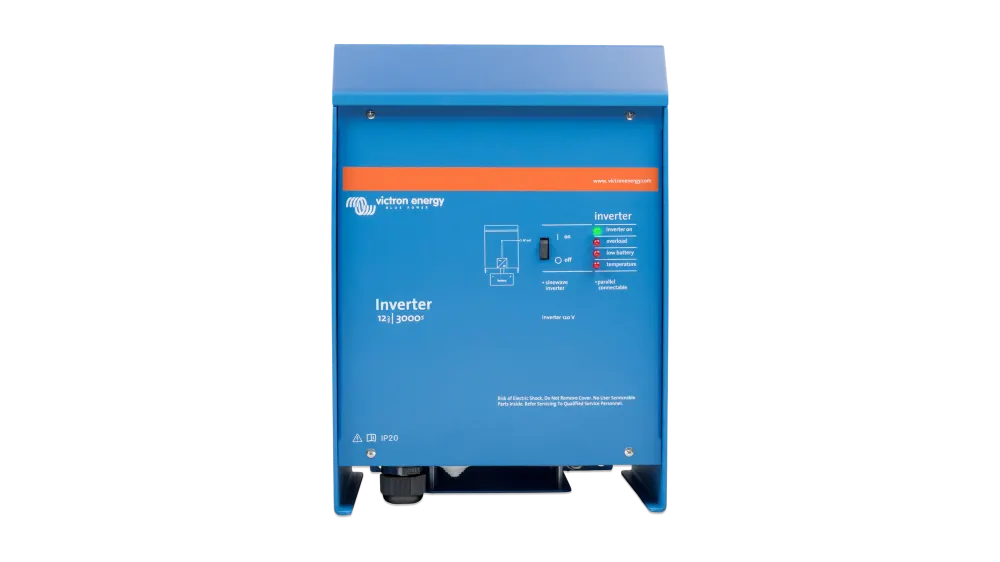
About the Phoenix 12/3000 Pure Sine Wave 120V Inverter The Phoenix 12/3000 takes in 12V DC and outputs 120V, 60Hz pure sine wave power. That is the entire job. There is no charger, no AC input, and no transfer switch, so shore or generator power cannot pass through the unit or be blended with battery power. That makes it the right pick when charging is already handled by an MPPT controller, a DC-DC charger, or a standalone AC charger, and the only gap is clean AC output. It is also the right pick when AC loads need to stay permanently isolated from utility power. Continuous Power Output and Temperature Derating The 2,400W rating is measured at 77°F. Victron publishes the full curve: 2,200W at 104°F and 1,700W at 150°F. Cooling is fan-assisted and the unit runs from -40°F to 150°F, so it keeps working in a hot space, just at lower continuous output. Size against the temperature the inverter will actually see. A ventilated equipment room supports the full 2,400W. A sealed RV bay, an engine room, or an uninsulated garage should be sized to 2,200W or below. 6,000W Surge Capacity for Motor Loads Peak output is 6,000W, more than double the continuous rating. Victron credits its SinusMax topology, which pairs high-frequency conversion with line-frequency output handling. In practice this starts loads that stall lower-surge inverters: refrigeration and air conditioning compressors, well pumps, air compressors, table saws, and most single-phase induction motors. The battery side has to keep up. A 6,000W surge at 12V nominal pulls over 500A for the duration of the start, and the bank, busbars, and cable all have to deliver it without terminal voltage sagging under the 9.5V cutoff. Undersized DC wiring is the most common reason a correctly sized inverter will not start a motor. Parallel, Split-Phase, and Three-Phase Operation Up to six identical units tie together over VE.Bus with standard RJ45 UTP cables, giving 18kVA and 14.4kW continuous in a six-unit stack. Two units configured for split phase produce 120/240V from a 12V bank, which covers North American 240V loads such as a well pump, a dryer, or a mini split. Three-phase wye is supported, but three-phase delta is not. VE.Bus Configuration and GX Monitoring Two RJ45 VE.Bus ports handle both inter-unit communication and system integration. Tied to a Cerbo GX or Ekrano GX, the inverter reports into the VRM Portal remotely, with alarms by email or push notification. Deeper configuration runs through VEConfigure with an MK3-USB interface. Adjustable parameters include output voltage from 95-128V, frequency at 50Hz or 60Hz, over- and under-voltage thresholds, and relay behavior. A VE.Bus Smart Dongle adds Bluetooth access where there is no GX device. Onboard DIP switches cover the common settings without a computer: AES mode, 115V or 120V output, and 50Hz or 60Hz.
Warranty terms mentioned in this description are the manufacturer’s. Our own coverage is the 30-day limited warranty.