How to charge a portable power station with solar panels
Check three numbers on the power station: maximum solar input watts, the input voltage range, and maximum input current. Choose panels whose combined open-circuit voltage stays below the voltage limit, even on cold days, and whose wattage roughly matches the input rating. Expect real output of about 70 to 80% of the panel rating.
Part of our home backup planning guides. Start with How to size a battery backup system for your home.
Which power station specs matter for solar?
Find the solar or DC input section of the spec sheet. You need the maximum input power in watts, the input voltage range (for example, 12 to 60 V), and the maximum input current in amps. The station’s charge controller will not use more than the maximum watts, and voltage above the range can damage it.
Why does panel voltage matter more than wattage?
A panel’s open-circuit voltage (Voc) is the voltage it produces with nothing connected. Voc rises as temperature falls, so a panel produces more voltage on a cold, bright morning than its label shows. Leave headroom: keep the combined Voc of your panel string comfortably below the station’s maximum input voltage, and check the panel’s temperature coefficient if you charge in freezing weather.
Should I connect panels in series or parallel?
| Series | Parallel | |
|---|---|---|
| What adds up | Voltage | Current (amps) |
| Works well when | The station has a wide voltage range | The station has a low voltage limit but a higher current limit |
| Shading | Shade on one panel lowers the whole string | Shade affects each panel more independently |
| Extra parts | Usually none beyond cables | Branch connectors (for example, MC4 Y-connectors) |
Example: two panels, each with a Voc of 24 V and a rating of 200 W. In series they reach 48 V, which fits a station with a 60 V limit. In parallel they stay at 24 V but double the current, which only works if the station’s current limit allows it.
How long does a solar recharge take?
Panels are rated under standard lab conditions, and heat, sun angle, and haze reduce real output. We plan with 75% of the rated wattage during good sun. Charge time ≈ battery capacity ÷ (panel watts × 0.75).
Example: a 1,152 Wh station with 400 W of panels gets about 300 W in good sun, so it refills in roughly 3.8 hours of strong sunlight. To estimate how much sun your location gets through the year, NREL’s free PVWatts calculator models solar output by address.
What else helps solar charging?
- Point panels at the sun and adjust the angle a few times a day; portable panels have kickstands for this.
- Keep panels out of partial shade, since even a shadow across one cell reduces output.
- Use the connector or adapter the station manufacturer specifies, and keep cable runs reasonably short.
- Keep the power station itself in the shade; batteries charge more slowly when hot.
Pairing solar with storage is what makes a power station useful through longer outages. See how to size a home battery backup to work out how much capacity to pair with your panels.
Products to consider
Examples from our catalog that fit this guide. Check each product’s specifications against your own numbers before you order.
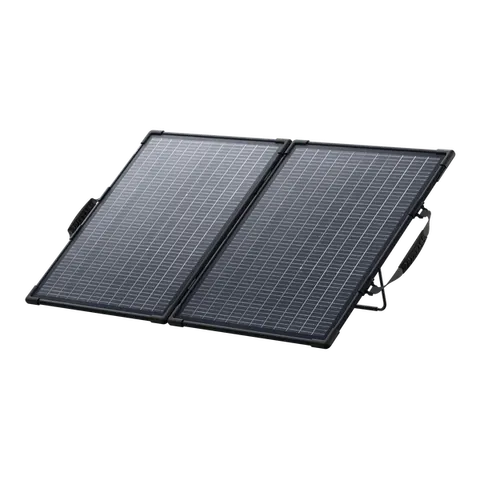
Anker SOLIX
Anker SOLIX PS100 Bifacial Portable Solar Panel
For campers and power station owners who carry their solar, the PS100 bifacial panel folds down and weighs just 7 lb with its stand. Anker describes it as 10% lighter than the previous version.
$224.99
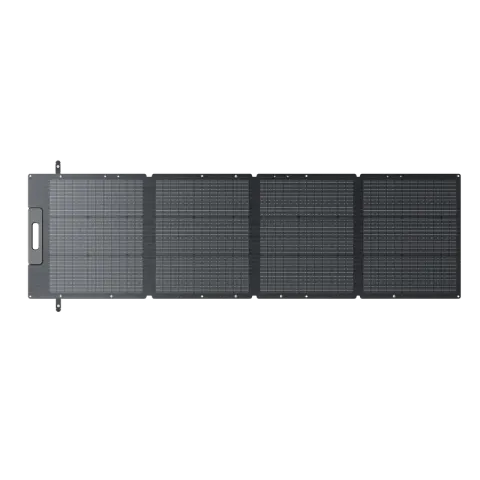
BLUETTI
BLUETTI 200W Portable Solar Panel
Monocrystalline cells rated at up to 23.4% efficiency give this BLUETTI 200W portable panel its output. It folds for transport and connects to most solar generators that use MC4 connectors.
$359.10
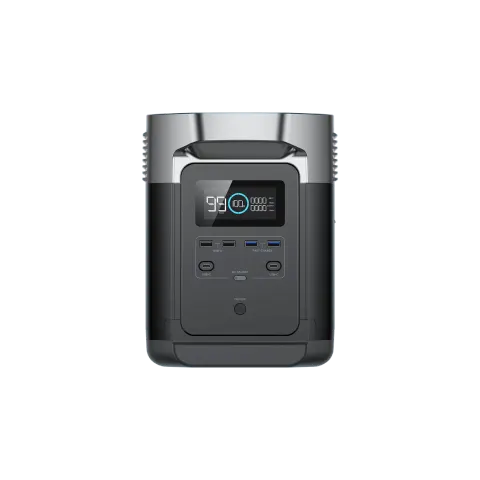
EcoFlow
EcoFlow DELTA 1300 Portable Power Station
With 1260Wh of capacity and six AC outlets totalling 1800W, the EcoFlow DELTA 1300 is a battery-powered generator for home and outdoor use. It charges from 0 to 80% in about an hour.
$636.65
Frequently asked questions
Can I use a larger solar panel than my power station’s input rating?
Extra wattage is generally fine because the station only draws up to its maximum input, and a slightly larger array helps in weak light. Voltage is the hard limit. The panels’ combined open-circuit voltage must stay below the station’s maximum input voltage, including on cold days.
Do I need a separate charge controller?
Most portable power stations have a built-in MPPT solar charge controller, so you connect panels directly to the solar input. A separate controller is usually needed only when charging a standalone battery bank that has no built-in controller.
Can I charge a power station with solar on a cloudy day?
Yes, but output drops sharply under heavy cloud, often to a small fraction of the panel rating. Plan on longer charge times in winter and in poor weather, and consider adding panel wattage if you rely on solar during outages.